
For as long as people have studied psychology, one question has remained at the center of the field: Why do we think, feel, and behave the way we do?
This inquiry is simple on the surface, but it opens the door to the deepest mysteries of the human experience. What is the mind? What is consciousness? Why do we suffer, and perhaps most importantly, how can therapy help us change?
As a therapist at Triad Psych, I have long been interested in the bridge between psychology and philosophy. The study of the mind is not only scientific; it is also deeply human. Every person who comes into our counseling sessions brings a private inner world: a complex tapestry of memories, beliefs, emotions, fears, and hopes that may not always be easy to explain.
To navigate this inner world, practitioners often lean on two major traditions in psychotherapy: classical Freudian psychoanalysis and Cognitive Behavioral Therapy (CBT). While they offer very different maps of the human psyche, both are essential tools for helping individuals and families find clarity and growth.
Freud: Looking Beneath the Surface
Sigmund Freud’s work helped shape the landscape of modern psychotherapy by suggesting that human behavior is often motivated by forces outside of our immediate awareness. In the Freudian tradition, symptoms are never random. Anxiety, avoidance, emotional conflict, and recurring relationship patterns are seen as signposts pointing toward deeper, unconscious material.
Freud believed that our adult personalities are heavily influenced by early childhood experiences, internal conflicts, and various developmental stages. While many aspects of classical Freudian theory have been debated and revised over the last century, one foundational idea remains incredibly influential: People are often shaped by stories and emotional patterns they may not fully recognize at first.
The Value of Depth in Modern Therapy
In a therapeutic setting, this deeper exploration is invaluable. A client may initially seek help for a specific, present-day problem: perhaps stress at work or a recurring argument with a spouse. However, through the lens of depth psychology, we may discover that the present difficulty connects to older experiences or long-standing patterns of relating to others.
By identifying these “under-the-surface” drivers, clients can understand not only what they are feeling, but why those specific feelings are surfacing now. This process of gaining insight is a hallmark of personalized mental health care, allowing for a more profound level of healing that goes beyond temporary symptom relief.

CBT: Understanding Thoughts, Feelings, and Behavior
If Freud looks at the “roots” of the tree, Cognitive Behavioral Therapy (CBT) focuses on the “branch es”: the visible patterns of how we interact with the world today. CBT takes a highly practical and structured approach to mental health.
The pioneer of cognitive therapy, Aaron Beck, observed that conditions like depression and anxiety are often maintained by “automatic thoughts.” These are rapid-fire interpretations of reality that feel true in the moment, even when they are distorted or unhelpful. Common examples of these cognitive distortions include:
- Overgeneralization: “I always mess things up.”
- Mind Reading: “No one really likes me; I can tell by how they looked at me.”
- Catastrophizing: “If I fail this one assignment, my entire career is over.”
The “Cognitive Revolution” and Practical Tools
CBT emerged during the “cognitive revolution” of the mid-20th century, shifting psychology toward a more empirical, evidence-based model. It helps clients slow down and examine their thoughts as if they were hypotheses to be tested. Is the thought accurate? Is it helpful? Is there a more flexible way to view the situation?
At Triad Psych, we often use CBT because it is structured and teachable. It provides clients with a “toolbox” of learning strategies they can use between sessions, such as:
- Thought Tracking: Journaling to identify triggers and automatic responses.
- Behavioral Experiments: Testing out new behaviors to see if the feared outcome actually happens.
- Coping Skills: Practical techniques like grounding or deep breathing to manage physiological distress.
- Problem-Solving: Breaking down overwhelming tasks into manageable steps.
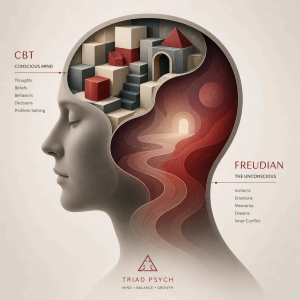
Two Different Views of the Mind
It is common to see Freudian therapy and CBT presented as opposites.
- Freud looks beneath the surface; CBT looks at the present pattern.
- Freud asks, “What unconscious conflict or early experience is influencing this?”
- CBT asks, “What thoughts and behaviors are maintaining this problem right now?”
However, in real clinical work, people are rarely that simple. A person may need immediate, practical tools to manage a panic attack (CBT), while also needing a space to explore why they feel a deep seated sense of unworthiness that stems from their upbringing (Freudian/Psychodynamic).
Why This Balance Matters for Families
This integration of approaches is particularly important when working with various age groups, including children and teens.
For example, a child struggling with ADHD or Autism may benefit from the structure and behavioral scaffolding provided by CBT-informed techniques. Simultaneously, the family might need a more psychodynamic approach to understand the emotional “meaning” behind a child’s behavior: treating a tantrum not just as a behavior to be extinguished, but as a communication of an unmet emotional need.
Teenagers, in particular, often navigate a complex landscape of identity and belonging. While they need coping skills to handle the pressures of school and social media, they also need a safe, non judgmental space to explore deeper questions about who they are and who they want to become.

Therapy as Both Science and Human Understanding
Modern psychotherapy continues to evolve, drawing from neuroscience, developmental research, and philosophy. We now know that human beings are not just machines to be “fixed” or computers to be “reprogrammed.” We are meaning-making creatures.
The power of therapy lies in its ability to create a specialized environment where science and human empathy meet. By utilizing evidence-based methods like CBT alongside a deep respect for the individual’s history and unconscious patterns, we can offer a more comprehensive path to wellness.
A Creative and Individualized Approach
There is no “one-size-fits-all” school of psychology. Some clients thrive with the clear goals and homework of CBT, while others find their greatest breakthroughs in the open-ended exploration of their inner life. Many find that a combination of both is what finally allows them to move forward.
At Triad Psych, our view is that therapy requires curiosity, creativity, and humility. The human mind is complex, and suffering does not always fit neatly into a single clinical model. But by remaining flexible and matching the approach to the person, therapy can help individuals name what they feel, notice what they think, and discover new ways of relating to themselves and the world.
About the Author: Dale C. Gillman

Dale Gillman known as the as the child/teen/play therapy/neurodivergent family guy provides therapy for children, teens, young adults, and families through Triad Psych. With a focus on play therapy, emotional regulation, ADHD, autism, anxiety, and family support, Dale integrates various therapeutic modalities to meet the unique needs of every client.
Are you or a loved one looking for support? To learn more about our services or to request an appointment with Dale or another member of our team, contact Triad Psych today. We provide expert psychological services across the Atlanta, GA, and Charlotte, NC areas, committed to creating a safe and supportive environment for your healing journey.