
For many neurodivergent individuals, the world can feel like it is constantly turned up to its maximum volume. Whether it is the hum of a refrigerator, the unpredictable chatter of a busy office, or the internal “noise” of a racing mind, sensory input can quickly move from background detail to a source of significant distress.
At Triad Psych, we believe that empowerment begins with understanding. Managing your environment is not about forcing the world to go silent; it is about developing the tools to regulate how you experience that world. This guide, rooted in the clinical insights of Terrance Putter, explores practical strategies for sensory regulation, mental clearing, and finding your steady ground in any environment.
The Philosophy of the Settled Mind
A common misconception in mindfulness and mental health is that the ultimate goal is a “blank mind.” As Terrance Putter notes in his professional guide, A Practical Guide for White Noise, Brown Noise, Sensory Regulation, Mental Clearing, and Body-Based Focus, most minds do not become blank on command.
Instead of fighting against the natural activity of your brain, the Triad Psych approach focuses on creating a settled mind. The goal is to provide a structure that helps your thoughts organize, settles your nervous system, and allows your attention to return to the present moment.
Identifying Sensory and Mental Overload
Many of our clients in the Atlanta and Charlotte regions come to us experiencing similar frustrations:
- Active Thoughts: A mind that feels like it is jumping from one unfinished task to another.
- Inability to Relax: Sitting down to rest, only to be flooded with memories of things left undone.
- Auditory Distractions: Every small sound in the environment: a fan, traffic, or distant conversation: pulls focus away.
- Sensory Sensitivity: Feeling overwhelmed by “normal” levels of stimulation.
If these experiences resonate with you, it is important to know that they are common reflections of stress, sensory sensitivity, or the mind’s natural tendency to keep unresolved information active. Our team, including clinicians like Dale Gillman and Sheri Locklear, specializes in helping clients move from a state of overwhelm to one of self-management.
Strategy 1: Sound Masking for Environmental Control

One of the most effective tools for immediate sensory regulation is sound masking. This involves using a steady, predictable background sound to reduce the impact of unpredictable environmental noise.
Unpredictable sounds: like someone talking in the next room or sudden traffic: are often the most disruptive because they force the brain to orient toward the “threat” or change in the environment. By introducing a steady sound, such as a fan, rain track, or a dedicated white/brown noise machine, you give your brain a predictable auditory “floor.”
Choosing Your Sound: White vs. Brown Noise
While many are familiar with white noise, which has equal intensity across all frequencies (sounding similar to “static”), many neurodivergent individuals find brown noise more soothing. Brown noise has more energy in the lower frequencies, creating a deeper, rumbly sound like a distant waterfall or a low hum.
When selecting a sound mask, ask yourself: “Does this sound help my body feel steadier, or does it make me feel more irritated or alert?”
Strategy 2: Sensory Anchoring

When your attention begins to wander or your thoughts feel “too active,” a sensory anchor provides a safe place for your mind to land. In Terrance Putter’s guide, he describes an anchor as a neutral, steady point of focus that you can return to whenever you feel pulled away by internal or external distractions.
While many use the breath as an anchor, sound can be equally powerful. A steady low-frequency sound serves as a reminder that you are in the here and now. By focusing on the sound, you aren’t trying to stop your thoughts; you are simply giving your attention a predictable home base.
Strategy 3: Arousal Regulation and “Heavy Work”
Empowerment through sensory management also involves understanding your body’s level of arousal. Too little stimulation can lead to restlessness and “mind jumping,” while too much leads to sensory overload.
Our learning strategies often incorporate “heavy work” or proprioceptive input alongside sound based tools. Activities like using a weighted blanket, wall push-ups, or simply firm grounding pressure can help organize the nervous system, making it easier to utilize sound masking and mental clearing techniques.
Implementing Regulation Tools with the Triad Psych Team
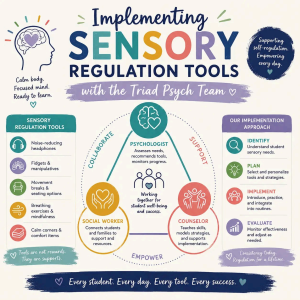
At Triad Psych, we don’t just provide information; we work with you to build a personalized “sensory toolkit.” Clinicians like Dale Gillman and Sheri Locklear are experts at helping clients translate clinical concepts into daily habits.

Whether you are seeking neurodiversity support in Atlanta or specialized autism treatment in Atlanta, our team is dedicated to providing a supportive environment for your growth. We help you navigate the nuances of sensory regulation, from choosing the right frequency of noise to developing written “thought-clearing” routines that allow you to park unfinished tasks so your mind can finally rest.
Finding Genuine Confidence Through Self-Management

Mastering your environment is a key component of mental health and personal empowerment. When you understand how to regulate your sensory inputs, you gain the confidence to navigate spaces that once felt overwhelming: whether that is a classroom, a workplace, or a social gathering.
If you are looking for professional guidance on managing sensory sensitivity or seeking neurodiversity support in Atlanta, GA, the team at Triad Psych is here to help. Our personalized approaches, rooted in evidence-based methods and the practical expertise of clinicians like Terrance Putter, ensure that you have the tools you need to thrive.
Take the first step toward a more settled mind. Contact us today to learn more about our individual therapy and assessment services.