
Temple Grandin once described to Dr. Stephen Porges the feeling of a lion being present when there was no lion in sight. As Porges recounted in a 2022 talk, the image captures something important: a person can feel threatened even when others do not see an obvious danger.
For some autistic people, a loud room, unpredictable change, or difficult social situation can feel overwhelming. That experience deserves attention, not judgment. Polyvagal Theory offers one way to think about how a sense of safety and stress may shape social engagement. It can be a useful clinical lens, but it is not a complete explanation of autism, and it remains debated.
This is Part 1 of a two-part series. It revisits an earlier discussion of Asperger Syndrome and relationships, including alexithymia and Cassandra Syndrome, and looks at the theory itself: what Polyvagal Theory claims, what the evidence supports, and where it is contested. Part 2, Polyvagal Theory Is a Dream Come True for the Neurodivergent, turns to the practical side: how clinicians and clients use the three-state map and concrete skills when the environment cannot be changed. It also reflects a basic principle of science: ideas should be reviewed and revised as evidence develops.
What Polyvagal Theory Says About Safety
Dr. Porges’s Polyvagal Theory focuses on the autonomic nervous system, which helps regulate body functions such as heart rate and breathing. The theory proposes that the vagus nerve and other pathways are involved in how people respond to safety and threat, including their capacity for social engagement (Porges, 2022).
Porges uses the term neuroception for the nervous system’s detection of cues that may signal safety, danger, or life threat. In everyday terms, someone may react to a situation before they can explain what feels wrong. A fluorescent light that flickers, several conversations happening at once, or a sudden change in someone’s tone may contribute to distress. The same stimulus will not affect everyone in the same way.
It can be helpful to ask: Could this person’s body be responding to overwhelm or uncertainty, rather than choosing not to cooperate? That question does not tell us exactly what is happening, and it does not mean every behavior has a single cause. It can, however, help adults respond with curiosity instead of assuming defiance.

Autism Is Not Simply a State of Feeling Unsafe
Autism is a neurodevelopmental condition. Polyvagal Theory should not be used to suggest that autism is caused by feeling unsafe, or that autistic people are all in a chronic state of threat. Research on autonomic functioning in autism is mixed, and findings do not support one universal pattern for all autistic people.
Some researchers and clinicians find the theory useful for considering how stress and social context affect an individual. Others challenge its physiological claims and the way some of its concepts are applied. For example, Barbier, Chen, and Huizinga (2022) argue that existing autonomic research does not support treating abnormal autonomic function as a defining feature of autism.
A balanced position is important: the theory may offer questions to explore, but it is not settled science or a stand-alone account of autism. An individual’s sensory profile, communication, health, environment, and personal experience all matter.
How Stress, Meltdowns, Shutdowns, and Stimming May Connect
When a person is anxious, overwhelmed, or experiencing trauma-related stress, it may become harder to communicate, think flexibly, or stay engaged. Chua (2023), discussing earlier work by Hirstein, Iversen, and Ramachandran (2001), considers how heightened stress may contribute to autistic meltdowns or shutdowns. This is one possible way of understanding some experiences, not proof that all meltdowns or shutdowns have the same cause.
Stimming, such as rocking or hand flapping, may help an autistic person regulate sensory or emotional input. It may also be enjoyable or communicate something important. A neurodiversity-affirming approach does not treat stimming as a behavior to eliminate simply because it looks different. The relevant questions are whether the person is safe, whether they need support, and what the behavior may be doing for them.
Auditory Sensitivity: When Hearing Is Not the Same as Listening Comfortably
Some autistic people have typical hearing-test results and still find everyday sound difficult. They may be sensitive to particular noises or struggle to follow a voice when background sounds compete for attention.
Porges and colleagues (2014) examined the Listening Project Protocol (LPP), an intervention using filtered music. Their paper proposed that middle-ear muscle regulation might affect how speech and other sounds are processed. The study reported preliminary findings related to auditory sensitivity. It did not establish that the proposed mechanism explains autism or that the protocol is an effective treatment for every autistic person.
The paper also notes important limitations, including reliance on parent reports and the inability to confirm the specific neural pathways involved. The LPP is distinct from the Safe and Sound Protocol (SSP). SSP is described as a practical application associated with this broader approach, but its proposed mechanisms and suitability should not be assumed. It is not a cure for autism or a replacement for individualized care.
What a Polyvagal-Informed, Neurodiversity-Affirming Therapy Approach Can Look Like
A therapy approach informed by safety and regulation pays attention to the person’s experience before asking them to manage a challenging task. It does not assume that compliance is the same as progress.
In practice, a clinician may:
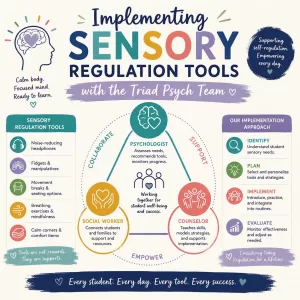
- Adjust the environment. Reduce unnecessary noise or visual distractions, offer seating choices, and make the session’s structure clear.
- Set a pace that supports participation. Allow breaks and avoid pushing for conversation or social interaction when the person is overwhelmed.
- Support co-regulation. Use a steady, respectful presence and communicate in ways that feel clear and predictable to the client.
- Respect self-regulation. Allow safe stimming and consider what the person may be communicating through movement, speech, or withdrawal.
- Build trust before targeting goals. If the client wants to work on communication or social skills, begin in a way that respects their needs and priorities.
This is not about avoiding growth. It is about making support accessible enough for growth to be possible. Goals should be developed collaboratively with the autistic person and, when appropriate, their family.

Practical Takeaways for Parents
- Look for patterns. Notice whether distress follows particular sounds, lighting, transitions, social demands, or changes in routine.
- Ask what might help. Offer simple choices, such as a quieter space, headphones, a break, or more time to respond.
- Prioritize communication and safety. During a difficult moment, focus first on reducing demands and understanding what the child needs. Discuss lessons or plans later, when everyone is ready.
- Respect stimming. Do not try to stop safe behavior just because it is unfamiliar. If it risks injury or interferes with daily life, seek individualized guidance rather than relying on punishment.
- Keep an open, evidence-aware mind. Polyvagal Theory may offer useful questions, but it is not the only framework for understanding an autistic person’s needs. Ask clinicians to explain the evidence, limitations, and alternatives for any proposed intervention.
Autism and Neurodiversity Support at Triad Psych
If you are seeking neurodiversity support in Atlanta, GA, or autism treatment in Atlanta, a conversation with a clinician can help clarify what kind of support may fit your family. Triad Psych provides autism and neurodiversity services for individuals and families in Atlanta, Marietta, Acworth, Carrollton, and Charlotte, NC. Our clinicians can discuss sensory, emotional, and relationship concerns and help you consider next steps. You may also ask about polyvagal-informed approaches and whether tools such as SSP are appropriate; Triad Psych does not claim to offer SSP.
Learn more about Triad Psych’s autism and neurodiversity services or schedule a consultation. We welcome people seeking therapy in Charlotte, NC, and mental health services in Atlanta, as well as families looking for thoughtful, individualized support.
References
- Barbier, A., Chen, J.-H., & Huizinga, J. D. (2022). Autism spectrum disorder in children is not associated with abnormal autonomic nervous system function: Hypothesis and theory. Frontiers in Psychiatry, 13, 830234. https://doi.org/10.3389/fpsyt.2022.830234
- Chua, C. K. (2023). Using polyvagal theory to understand autistic meltdown. Asian Journal of Interdisciplinary Research, 6(4), 10–17. https://doi.org/10.54392/ajir2342
- Hirstein, W., Iversen, P., & Ramachandran, V. S. (2001). Autonomic responses of autistic children to people and objects. Proceedings of the Royal Society B: Biological Sciences, 268, 1883–1888. https://doi.org/10.1098/rspb.2001.1724
- Lovett, J. P. (2005). Solutions for Adults with Asperger Syndrome: Maximizing the Benefits, Minimizing the Drawbacks to Achieve Success. Fair Winds Press.
- Porges, S. W. (2022). Polyvagal theory: A science of safety. Frontiers in Integrative Neuroscience, 16, 871227. https://doi.org/10.3389/fnint.2022.871227
- Porges, S. W., Bazhenova, O. V., Bal, E., Carlson, N., Sorokin, Y., Heilman, K. J., Cook, E. H., & Lewis, G. F. (2014). Reducing auditory hypersensitivities in autistic spectrum disorder: Preliminary findings evaluating the Listening Project Protocol. Frontiers in Pediatrics, 2, 80. https://doi.org/10.3389/fped.2014.00080