
Polyvagal Theory can be a dream come true for the neurodivergent, not because it can make every overwhelming place feel safe, but because its language may help make intense body sensations easier to notice and respond to.
A crowded waiting room. Fluorescent lights. Conversations overlapping from every direction. You have an important appointment, and leaving is not a simple option. Your body is already signaling that the input is too much.
For many neurodivergent people, the fear is not just “I might feel uncomfortable.” It is the possibility of overwhelm: anxiety and dread escalating until it becomes difficult to think, communicate, or stay in the situation. Sometimes the result is a meltdown. Sometimes it is withdrawal or shutdown.
This is Part 2 of a two-part series. In Part 1, we looked at the theory itself: what Polyvagal Theory claims about safety and the nervous system, what the evidence supports, and where it is contested. This part is the practical side: the three-state map and the skills that help when the room cannot be changed.
Changing the environment, when possible, matters. But when the room cannot be changed, or you need to enter it to get something important done, learning to recognize your reactions and choose a next step can help.
That is where polyvagal-informed skills come in. They do not pretend the room will change. They give you something the room cannot take away: the ability to notice what your nervous system is doing, and do something about it. For the neurodivergent, that combination of concrete language and quick, repeatable steps is what makes this framework feel like a dream come true. It is not a cure for autism. It is a tool for the moments the world refuses to accommodate you.
From “Different Operating Systems” to States You Can Change
In our previous post about Asperger’s syndrome and relationships, we discussed ideas such as alexithymia and Cassandra syndrome. In Solutions for Adults with Asperger Syndrome (2005), Juanita P. Lovett describes neurodivergent and neurotypical people, in effect, as operating with different software. That metaphor explains a lot, but it leaves you stuck with a fixed system you can only work around.
Polyvagal Theory, associated with Stephen Porges, contests that framing. It directs attention to a different question: What is happening in your body when you experience a situation as safe, stressful, or overwhelming — and can you do something about it in real time?
Porges has argued for the importance of felt safety in social engagement and regulation. In a PESI talk, he recounted that Temple Grandin had described feeling as if a lion were present in a situation where there was no literal lion. The image conveys how intense a threat response can feel, even when other people do not perceive the same danger.
That experience deserves to be taken seriously. It does not, however, mean that autism is simply a state of feeling unsafe. Autism is a neurodevelopmental condition with a range of traits and experiences. A framework about stress and safety cannot explain all of it.
Science also changes as evidence develops. New ideas may be useful, but they need to remain open to testing and revision.
The Three States: A Simple Map, Not a Diagnosis
Polyvagal Theory describes three broad response patterns. These labels can be used as a simple map for noticing what you might be experiencing, not as a medical diagnosis or a complete account of how the nervous system works.
- Ventral vagal: safe and socially engaged. You may feel present, connected, and able to think or communicate.
- Sympathetic: mobilized alarm. Your body may shift toward fight-or-flight responses. You might feel restless, tense, panicked, or ready to escape.
- Dorsal vagal: shutdown or collapse. You may feel numb, withdrawn, foggy, or unable to respond easily.
People can move between different states, and the pattern is not always tidy. Your experience may not fit neatly into any one label. The point is not to classify yourself perfectly. The point is to notice early signals and identify what could help next.

You Cannot Always Change the Room. You Can Look for a Next Step.
Coping strategies have long been a part of support for neurodivergent people. A useful feature of the polyvagal framework is that it gives some people concrete words for noticing activation or shutdown. A therapist may use those words to help you recognize patterns and practice responses.
But self-regulation is not a demand to tolerate every environment. If sensory input is painful or overwhelming, reducing it may be the most appropriate response. That could mean leaving, asking for a quieter space, using headphones, requesting an accommodation, or bringing someone you trust.
The goal is not to make you responsible for fixing a sensory-hostile environment. It is to help you have more options, especially when you cannot change the room right away.
A Five-Step Plan for the Moment Overwhelm Builds
This is where the framework earns its keep. Coping skills for neurodivergent people have always been popular in treatment, but rarely has there been a technique this simple and operational. Polyvagal therapy breaks the complex down into concrete terms, which is exactly what makes rapid relief possible. Try these steps when you notice overwhelm building. Adapt them to what feels comfortable and accessible to you. They are skills to practice, not a promise that distress will disappear instantly.
- Notice your early signals. Check for changes in your breathing, muscle tension, heart rate, thoughts, or ability to speak and focus. Your own pattern matters more than a checklist.
- Name what might be happening. You could say, “I’m getting overloaded,” “My body feels on alert,” or “I’m starting to shut down.” Use language that feels accurate to you.
- Reduce input where possible. Move to a quieter edge of the room, turn away from visual activity, put on ear protection, or ask to pause. Small changes may help; leaving is also a valid option.
- Choose a grounding cue. Press your feet into the floor, hold a familiar object, or look for a few neutral details around you. Try a slow, comfortable exhale if that feels okay. Do not force a breathing exercise if it makes you feel worse.
- Make one practical decision. Ask: “What do I need in the next two minutes?” You might ask for more time, use a prepared sentence, contact a support person, or leave and return later.
The goal is not to force yourself into a particular state. It is to notice what is happening, protect your needs, and find a manageable next action.
For parents, the same approach begins with curiosity rather than correction. Ask your child what feels difficult. Reduce avoidable sensory demands. Offer simple choices, such as taking a break or using headphones, and avoid assuming that a child who looks calm is comfortable.

Start With the Person and the Environment
Before asking someone to use a coping tool, consider what the environment is asking them to manage. Noise, crowds, unpredictable transitions, bright lights, and competing conversations can all add strain. A strategy that helps one person may not help another.
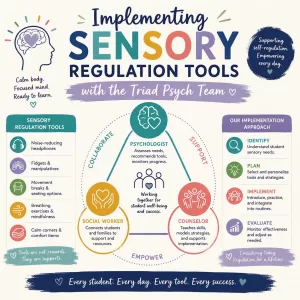
A practical plan might include identifying difficult situations, selecting tools that the person chooses, and checking whether those supports actually help. Headphones, fidgets, movement breaks, breathing exercises, and quiet spaces are examples, not one-size-fits-all solutions.
An Important Note About the Evidence
Polyvagal Theory has critics, and research does not support treating it as a settled explanation of autism. A 2022 review argued that existing heart-rate and heart-rate-variability research does not establish widespread autonomic dysfunction as a defining feature of autism. A 2025 expert evaluation also challenged core physiological claims of the theory. These publications reflect scientific debate; neither turns a theoretical framework into a proven autism treatment.
Sensory distress is real, but it does not prove that a person’s nervous system has misread danger. Sometimes the environment is genuinely too loud, bright, crowded, or unpredictable. Polyvagal language may help some people describe their experience, but it should not be used to label autistic behavior as faulty or to suggest that appearing socially engaged proves someone feels safe.
A balanced approach is to use the framework, if helpful, as one possible way to discuss stress and regulation, while respecting individual experience, making reasonable environmental changes, and drawing on appropriate clinical support.
Selected reading
- Barbier, A., Chen, J.-H., & Huizinga, J. D. (2022). “Autism Spectrum Disorder in Children Is Not Associated With Abnormal Autonomic Nervous System Function.”
- Grossman, P. (2025). “Why the Polyvagal Theory Is Untenable: An International Expert Evaluation.”
Support for Neurodivergent Individuals and Families
You do not have to work out your sensory needs or regulation strategies alone. Triad Psych provides neurodiversity-informed services for individuals and families, with a strengths-based approach that considers each person’s needs and goals.
Learn about Triad Psych’s neurodiversity and autism services and coaching for neurodiversity. To ask about availability in Atlanta, Marietta, Acworth, Carrollton, or Charlotte, NC, contact Triad Psych to schedule a consultation or call 470-338-3488.
Whether you are searching for neurodiversity support in Atlanta, GA, exploring autism treatment in Atlanta, or looking for therapy in Charlotte, NC, a consultation can help clarify which services may fit your needs. Polyvagal language may be one tool in that conversation, not a substitute for individualized care, accommodations, or the expertise of a qualified clinician.